
First, a few words of introduction. I had been thinking about writing this for several years. I discussed every topic with many experienced cold-water swimmers, including people who pass on the myths below with the best of intentions. We often found that something is repeated out of a kind of precaution: ‘Ota, if you say jumping into icy water is OK, someone will miss the part where you say it is not for beginners, jump in and hurt themselves.’
So please read carefully. Before criticising — which I expect, as anyone challenging accepted beliefs must — try to support your opinion with more than ‘that is what people say’. Jumping into icy water is the point people most often disagree with me about. My response is: OK, please give me one example of an experienced cold-water swimmer who died because they jumped into icy water.
Thank you to everyone willing to discuss this, but please keep it factual. We all love winter swimming, and insisting on something simply because THAT IS WHAT PEOPLE SAY will get us nowhere. You are welcome to call me on 792 349 539; I enjoy a real conversation too and look forward to hearing from you.
There is so much contradictory information about cold-water swimming online that some clarity is needed, and not just for beginners. Even the ‘official’ Czech winter swimming website contains claims — as of 18 November 2022 — such as swimming in water below 4°C burning 400 kcal per minute, cold-water swimmers not wearing gloves above −10°C, sleeping under a light cover in a 12°C room in winter, never taking a bath warmer than 37°C, and cold showers at home being an essential foundation. The worst part is that other ‘authors’ repeat these myths and misleading claims without critical analysis, or even a little common sense. The same ‘information’ then comes at you from every direction. So let us get started.
Myth 1: cold showers are the foundation of cold-water swimming. Before swimming in a cold river, you must prepare consistently with regular cold showers for several months.
You can read this almost everywhere, although it is hard to establish where the idea came from. It certainly appeals to practically everyone selling cold-exposure courses. Wim Hof’s business is the best-known example, but plenty of people in Czechia also sell something you can get more easily and for free. It is hard to build a business around my two-step approach: 1. Get your health checked. 2. Come swimming with me. Instead, you fill in charts recording how long you needlessly suffered in a cold shower, debate whether to breathe according to Hof, Buteyko or Kolář, and explore emotional processes — I am not making that up; one cold-exposure course really does cover emotional processes and techniques.
None of those activities need do you any harm. Some people enjoy a daily cold shower, though it puts most people off going any further. Others practise breathing techniques, do yoga, play a drum or become one with nature. All of that is fine, but it is certainly not essential. When it comes to entering icy water, I would say it helps about as much as listening to the Czech singing duo Eva and Vašek.
My conclusion: cold showers can be beneficial, but they are certainly not something you have to do before swimming in an icy river.
Myth 2: your head cannot acclimatise, so keep it dry. But we have swimming caps, a standard part of a winter swimmer’s kit, and earplugs too. Swimming with your head going under the water is perfectly possible. Ideally, start at the beginning of the season, and by January you may find your head no longer objects to being submerged in icy water. Many cold-water swimmers do front crawl or breaststroke, naturally getting their heads wet. If we agree that a person can get used to immersing their head, we can call that acclimatisation: getting accustomed to challenging conditions is what cold adaptation means.
My conclusion: like any other part of your body, your head can get used to the cold, allowing you to immerse it even with a thin swimming cap. Protecting your ear canals with earplugs is a good idea if your cap does not cover your ears.
Myth 3: you should swim in a woolly hat
Perhaps your introduction to cold-water swimming was joining a Facebook group with more than 10,000 members, mainly used to show off photos of people you probably do not know. You might have come away thinking that a woolly hat is the badge of someone so tough that they will get in the water when everyone else is wearing winter clothing.
The argument, if anyone offers one, is usually that you lose most heat through your head. Think about it: nine-tenths of your body is immersed in icy water! In other words, 90% of your body is losing heat around 25 times faster than the 10% represented by your head. Get a calculator out and you will see that the few joules saved by a bobble hat are tiny compared with the massive heat loss from the rest of your body. You may feel a little more comfortable, but if warmth and comfort are what you want, would it not be better to stay on the sofa eating crisps?
My conclusion: a woolly hat is not for swimming, in summer or winter. That is what a swimming cap is for.
Myth 4: you have to start in summer
If you want to start something, do not put it off until ‘sometime’. Want to lose weight, run, lift weights, give up alcohol or learn a language? Start now. Conditions are almost never perfect, and waiting for them can mean never starting at all.
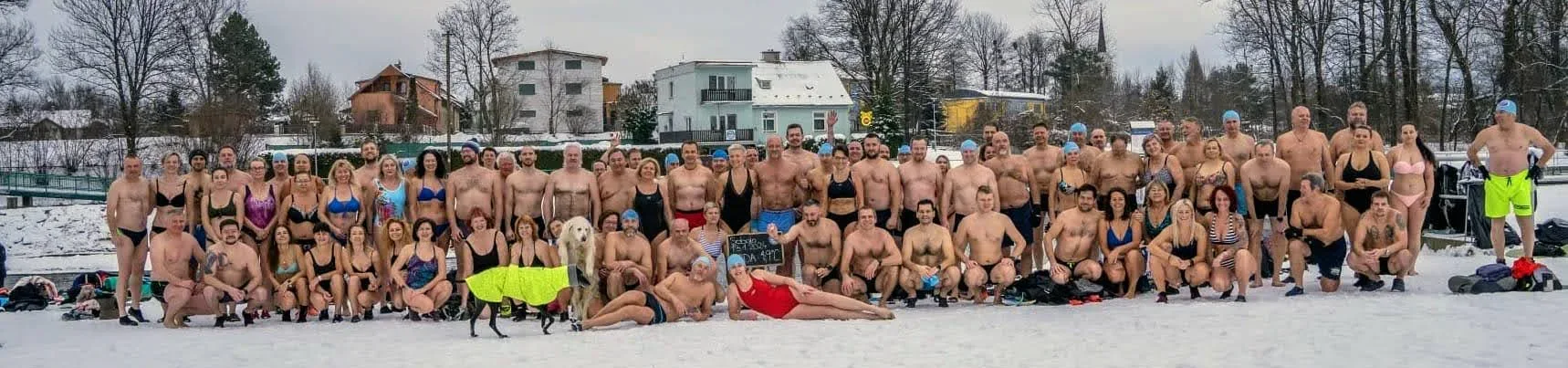
So how do you start in December, for example, when the river is at 3°C? First, get a medical check-up, ideally including an exercise ECG. Second, find a group that meets regularly: entering the water alone is an unnecessary risk. Third, get in and swim. You are not trying to break records; a few seconds is enough to begin with. If everything feels right, stay in a little longer next time. I take beginners into the water in Frýdek-Místek every Saturday throughout the winter. Feel free to write or call. It is free, fun and easier than it looks.
My conclusion: you can start at any time of year.
Myth 5: you need a course before you can swim in winter
You can spend your money however you like, but to my mind paying for a cold-exposure course makes about as much sense as paying for a course on eating bread and butter. To swim in icy water, you do not need to explore the mind and neuroplasticity, emotional processes or techniques. You do not need to think about breathing, Mother Earth, Wim Hof or your school sweetheart. What it takes is the willingness to come to the water, change into your swimming costume and step in. It is much easier than it looks, and if you are healthy, you can do it right now.
I have entered the water with hundreds of people on their first dip, and nobody has ever forgotten to breathe. Do not get distracted by things that do not matter; focus on the essentials.
My conclusion: a cold-exposure course may be enjoyable, like any time spent outdoors with interesting people, but it is not necessary before swimming in an icy river.
Myth 6: cold-water swimming makes you lose — or gain — weight
Some people use the claim that winter swimming burns 400 kcal per minute to recruit customers for paid courses: ‘Overweight? Just look at how much energy you will burn!’
In reality, energy expenditure is much lower. For comparison, depending on body weight and other factors, exercise typically burns a few calories to, at most, a few tens of calories per minute. Exceeding 20 kcal per minute means truly strenuous effort, such as competitive running, cycling or rowing. Common sense tells us that winter swimming, which an 80-year-old pensioner can manage, is unlikely to burn twenty times as much. And a few minutes of winter swimming certainly cannot be equated with several hours of heavy physical work.
There is another point: weight loss or gain depends on whether you consume less or more energy than you expend during the day, rather than on sport alone. The gym builds muscle; the kitchen determines the fat.
Others claim winter swimming increases body fat and makes you overweight. Again, that is faulty reasoning: seeing some overweight cold-water swimmers does not mean swimming made them overweight. They gained weight because they ate too much. Plenty of us eat sensibly and are not overweight.
My conclusion: a few minutes in icy water alone will not make you lose or gain weight. Cold exposure increases your total energy expenditure during the activity and especially afterwards, but nowhere near enough, in itself, to change your weight.
Myth 7: never jump into icy water — what we know about the risk for experienced swimmers
This is another ‘truth’ repeated as if it were set in stone, often without any context. I can only speculate about its origins. I can readily imagine a person dying after accidentally falling into icy water, with cardiac arrest identified at post-mortem rather than hypothermia or drowning. But without knowing the circumstances, that case cannot automatically establish the same mechanism in a healthy, prepared and experienced winter swimmer entering the water deliberately.
There is a huge difference between a car crash ending in an icy pond — darkness, stress, a fight for your life, shock and cardiac arrest — and jumping in calmly, prepared for exercise and experienced in swimming in icy water. You know what to expect; there is no surprise, and the water feels familiar. Do you see the distinction? Both involve sudden immersion in icy water. One can kill you; for the other, I have not been able to document a comparable serious outcome in a healthy, experienced cold-water swimmer.
Hundreds of swimmers enter the water from a pontoon every year at the Alfred Nikodém Memorial winter swimming competition. They do not jump; they use a ladder. Even so, the immersion itself takes a second or sometimes less, though some people take longer. You can see them splash in, and no, they do not die: they swim.
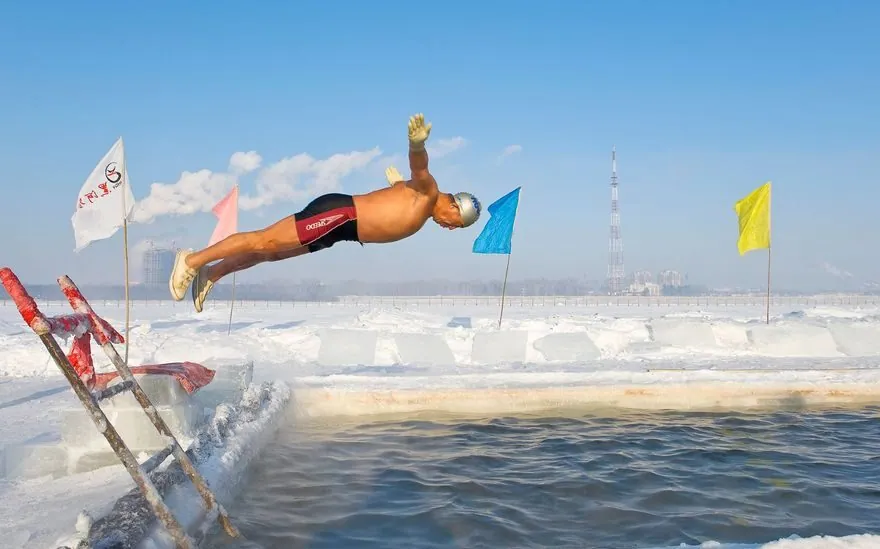
At U Žida, some of us have a tradition of jumping into the icy Ostravice together. This is not something I recommend to beginners. If you have winter swimming experience and know a safe spot, however, you can make an informed decision about whether to try it. We certainly do not dive head first — a spinal injury is not worth it. We land bottom first. It is great fun and makes an entrance that is both spectacular, with a satisfying splash, and enjoyable.
I have not been able to document cardiac arrest occurring immediately on a deliberate entry into icy water by a healthy, experienced cold-water swimmer, despite searching widely. In the deaths and collapses I found, the cause, the person’s experience or the method of entry were not described clearly enough to use them honestly as evidence.
We discuss the evidence and its limitations in Transcript: Ota Zemek’s discussion with AI about cold-water shock.
If someone asks whether I can guarantee that their heart will not stop during winter swimming, my answer is no. Cardiac arrest can happen during sport, walking or sleep, and it can also happen in icy water. That does not mean every winter swim is inherently life-threatening: the specific risk depends on health, experience, conditions and how you enter the water.
My conclusion: I have found no evidence that a controlled, feet-first jump into icy water poses a greater cold-water shock risk for a healthy, experienced winter swimmer than another equally rapid entry. That is neither a guarantee of zero risk nor a recommendation for beginners. You must always know the depth is safe, what lies on the riverbed and how to get out immediately. A swimming cap and protection for the ear canals are advisable.
Myth 8: a hot drink will warm you up after an icy swim.
Unfortunately, I do not think it will. It may feel pleasant, but it will not meaningfully warm you up. The time spent trying to lift a mug of tea to your lips with shaking hands would be better spent moving. In physical terms, think of yourself as an 80-litre barrel of water at about 36°C. How much will a mug of warm water raise that temperature? Hardly at all. Movement — ideally running or exercise — raises your temperature.
My conclusion: a warm drink after swimming is pleasant, but it warms you about as much as listening to a favourite song. Go for a run.
Myth 9: alcohol before or after winter swimming is life-threatening because it dilates blood vessels and increases heat loss.
It is true that alcohol-induced dilation of blood vessels increases heat loss, but there is an important qualification. Most people swim for only a few minutes, which is not long enough to freeze to death, with or without alcohol. The real danger of alcohol lies elsewhere: impaired judgement. Someone under its influence may overestimate their ability and stay in far longer than they can cope with because they feel warm. Coordination and orientation are worse; they may swallow water, react poorly and drown. Drinking is certainly inappropriate, in my view primarily because of risky behaviour with potentially fatal consequences, rather than because of heat loss.
If you normally go for a beer with friends after sport, I see no reason not to do so after swimming. You will not freeze.
My conclusion: when winter swimming lasts only a few minutes, the main danger of alcohol is poor decisions and worse reactions to unexpected situations, rather than heat loss. Author’s note: I never drink alcohol myself. I want to make clear that I am not defending something I personally do.
Myth 10: stand still in the water to conserve body heat.
Shipwreck survival guides sometimes say movement wastes heat and it is better to wait quietly for rescue. So yes, if you are floating in waves in a lifejacket, keep movement to a minimum — unless you have a chance of reaching shore, which is better than relying on an uncertain rescue. Staying still might save your life if it allows you to survive 50 minutes instead of 45 and help arrives in minute 47.
But if that is not your situation, and you have simply come for a five-minute swim in an icy river, then swim and move. Here is an example: try standing outside for half an hour in shorts and a T-shirt in January at 5°C. Just stand there. You will almost certainly get chilled and may become ill. Now try running for that half-hour in the same clothes. You will feel comfortable and be fine. Cold is all right, but it calls for movement.
You often see people standing in icy water on Facebook. Sometimes they have simply chosen a spot with too little space to swim. The solution? Go somewhere else.
My conclusion: in cold conditions, it is better to move, both in the water and on land.
That is about it. Have a lovely day, and I look forward to seeing you by the water.