
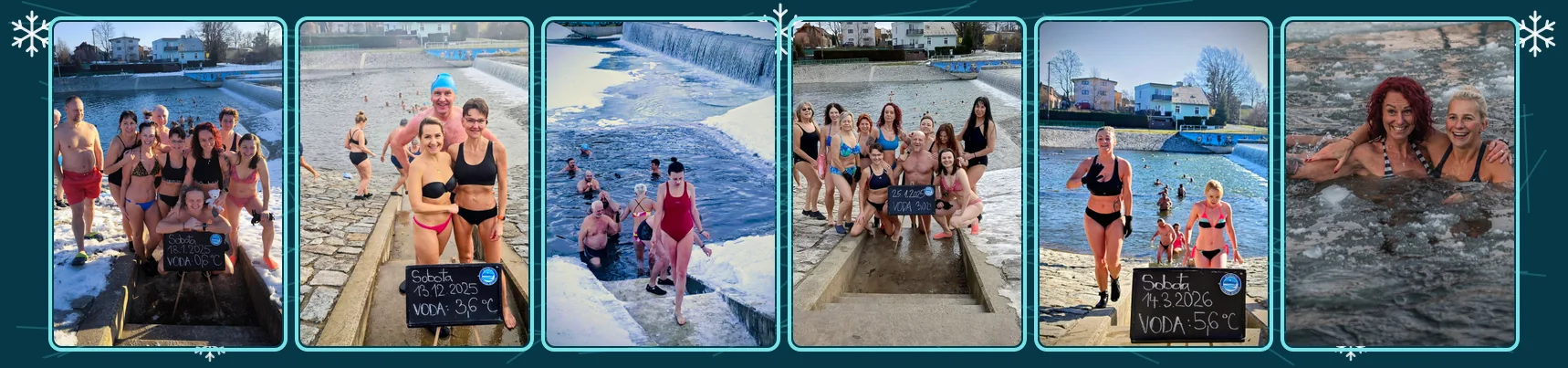
Cold acclimatisation takes little time or money and can support the immune system. Winter swimming — in our case, in a river — is one of the most effective ways to practise it, and it is great fun. Almost everyone has tried cold showers, but few keep them up. Surprisingly, river swimming is often easier to stick with. Regularity and consistency are what make acclimatisation work.
Swimming together in the Ostravice below the U Žida weir makes getting started much easier. That does not mean the beginning is effortless: there will be some discomfort to overcome, just as when taking up any sport. People already used to exercising may find it a little easier.
Here is why, once you decide to try cold-water swimming, joining our group is better than going alone or with a very small group.
Swimming alone puts your health or life at risk. You might feel unwell while getting out, fall, hit your head and drown half a metre from the bank. You might overestimate your ability, stay a few minutes too long, become disoriented on land and succumb to the cold. Always swim with at least one other person and look out for each other.
Small groups often struggle with consistency. If two people in a group of three cannot make it, you either go alone — a bad idea — or do not go at all. Our group ensures you always have company in the water.
- The group carries you along. Some days, getting in is harder: you are tired, short of sleep or not at your best. Seeing dozens of other people confidently changing and heading into the river makes it much easier to take that step yourself.
- You will build good habits from the start. Having a beer by the river in January and swimming across once does not make you a cold-water swimmer or bring meaningful health benefits. Those come from making swimming a habit, ideally three times a week all winter, and staying in only as long as is appropriate for you. Longer is not better. Alongside regularity and consistency, gradual progress is the third pillar of sensible cold acclimatisation. If your first swim is in January, you will not stay in as long as someone who has been coming since November.
- You will acclimatise your whole body, rather than your body minus your hands — an odd habit that has appeared in recent years. Acclimatising your hands makes sense for two reasons: after a relatively short time, your fingers may feel less cold in everyday life, just like your feet, which nobody keeps out of the water; and your hands propel you in any ordinary swimming stroke. Standing stiffly with your hands raised as if in prayer, waiting for a Facebook photo, makes little sense to me.
- You will use appropriate equipment. You will rarely see one of us swimming at U Žida in a fur or woolly hat. Until the 2025/2026 season, I sent people wearing non-swimming hats back to the bank, but I have decided to stop. I will explain why I think it is unhelpful, but I no longer want to spend energy enforcing it. A slightly imperfect approach to cold exposure is better than none, so I will leave people who cannot imagine swimming without a hat to it.
Of the many winter swimming spots around Frýdek-Místek, I chose U Žida, the Staroměstský weir, for several reasons. It is easy to reach on foot or by car, with parking around 100 metres away, plenty of room for clothing, steps into the water, a still-water pool for less confident swimmers and the flowing river for more experienced people. At normal water levels, you can touch the bottom across the whole river, so you can stand if you tire.
Before swimming, we clear a reasonable amount of snow and ice from the steps and spread sand to help prevent accidents.
For anyone wanting to start, here is a brief description of how it works.
We meet every Monday and Wednesday at 4pm and Saturday at 9am. It is usually cold, and we get plenty of that in the water, so we wait no more than five minutes for latecomers. Sometimes we take a group photo, then swim. If this is your first dip, let me know beforehand and come on Saturday at 8.45am. Before everyone else arrives, you will receive an introduction and safety briefing. Everyone takes their first dip with me, for no longer than the time I specify. Others swim according to their ability and preference. We rarely stay in icy water longer than fifteen minutes; usually everyone is out within ten, and most swim for less than five. That is ample time to build cold tolerance.
Someone usually photographs the swim, and pictures appear here and on Facebook. If you do not want to be photographed, just say so. If you find a published photo unflattering, I will gladly remove it straight away. For most people, the pictures make a lovely keepsake.
If you stay in longer than a minute or two — it varies between people — sooner or later you may experience post-swim shivering. It usually starts while changing or after you are dressed, rather than in the water, because core cooling occurs with a delay. Going straight home in that state and shivering all evening is unpleasant and unhelpful. We warm up through movement. Once everyone is out and dressed, you can join a very gentle twenty-to-twenty-five-minute run, paced for the slowest person. Depending on the weather and mud, we run upstream along the Ostravice or Morávka and back. This is usually enough to feel comfortable again, even after ten minutes in 1°C water.
Everyone swims at their own risk and takes responsibility for themselves. Before taking up winter swimming, I strongly recommend an exercise ECG test and a discussion with your doctor about whether the activity is appropriate for your health.
Suggested times in the water for beginners
| Water temperature | Suggested time |
|---|---|
| 16–20°C | 12–18 minutes |
| 12–16°C | 8–14 minutes |
| 8–12°C | 4–10 minutes |
| 4–8°C | 2–6 minutes |
| 0–4°C | 1–4 minutes |
Especially in your first season, if your fingers remain numb or tingly the next day, follow the rule ‘one minute in the water for each degree above zero’. Keep to that, and next year will probably be easier.
We are all on first-name terms, regardless of age or gender.
Ideally, arrive in clothes you can run in, with your swimwear already underneath and a towel and optional water shoes in a running-friendly backpack. Change, swim, put your running clothes back on, pack the wet things and set off with your bag. Do not expect time to take things to the car between swimming and running. Water shoes protect against glass or other sharp objects on the bottom. If you swim throughout, you may not need them; most people go without.
A reminder: for your first swim, let me know beforehand and arrive on Saturday at 8.45am. You are welcome to watch any session first to see how it works, but first dips take place on Saturdays.
I look forward to meeting you and hope you enjoy swimming in cold water too.
Information before your first dip in cold or icy water
Dear prospective swimmer,
I am pleased you want to try acclimatising through cold-water swimming. I will accompany you through the first steps, offer support and do my best to help if a problem arises.
First, this is a very different experience from a cold shower, so it may feel unlike anything you have tried before. If you have not recently had a medical check-up, ideally including an exercise stress test, you can still reconsider and see a doctor before entering the water. That cannot guarantee how your body will react, but an exercise ECG and medical advice can help you decide.
Whether or not you have had a check-up, you are an adult with legal capacity and understand the risks associated with an extreme sporting activity. You enter voluntarily. I am helping and want to make the experience as pleasant as possible, but you remain responsible if a health problem and its consequences arise. That is for clarity. If you agree and sign below, we can enter the water.
I go in first and wait for you, so please do not keep me waiting too long — remember, the water is cold! Come down the steps towards me and try a few swimming strokes straight away. It helps your breathing, and time passes more easily when you are doing something rather than standing still. Movement is better than no movement.
I will stay close throughout and keep talking to you. We will aim to stay in for the time I set according to the water temperature, perhaps only a minute or two, or less, on your first dip. There is no rush: we start very gradually. I usually film these first swims, giving you a keepsake and helping people who are still undecided see how manageable it can be.
You may feel a mixture of discomfort, pain and euphoria. Before you have time to analyse it all, we will be getting out. Please follow my instructions. If I say to get out, do so immediately; we can talk about it afterwards, all right?
As soon as you get out, dry yourself and dress. Your first dip will be short enough that substantial shivering is unlikely. If it happens, move: jog on the spot, run a little or do a few press-ups. I may still be swimming then. Before long you may be able to stay in longer too, but give your body time to adapt.
If you would like, I will accompany your second and third swims too. Then find a swimming partner — there are plenty of us — and come together. You are on your way to becoming a regular cold-water swimmer and enjoying its benefits. I will be happy to keep seeing you at the river.
If you decide to join, please read and print the form, sign it and hand it to me on Saturday.