
The internet is awash with advice on how to get used to cold water. As so often happens, the first thing you see is a paid course, a “unique method”, cold therapy, biohacking or a workshop where you spend several thousand crowns learning that cold water is cold and that you should breathe properly while you are in it.
If you are looking for advice on getting started with cold-water swimming, do not be put off by the idea that you first need to buy into a complicated method or purchase expensive equipment.
Let me say it plainly: you do not need a course, a guru or a special method to become a cold-water swimmer.
I am not saying that these workshops must be bad. You might enjoy the experience, meet some lovely people and find the encouragement you need. Just do not confuse an experience with a regular practice. A single supervised session in a tub does not make you a cold-water swimmer, any more than paying for one training session makes you a runner.
In reality, getting used to cold water is much simpler — which is precisely why it is difficult to build an expensive “secret system” around it. You need a safe place, sensible people, a little determination and, above all, a willingness to keep coming back.
I wrote the original draft of this article on 14 November 2023. I am publishing it for the first time on 21 August 2026, after a fresh review of its health claims and sources. It draws on my years of winter swimming in the Ostravice, taking newcomers in for their first dips, and watching what helps people keep going — and what reliably puts them off. I am not a doctor, and I am not trying to assess anyone's medical fitness over the internet. But I can tell the difference between practical experience and a rule that someone is simply copying from one website to another.
Myth one: you must spend ages taking cold showers before getting into a river
You do not.
If cold showers suit you, by all means take them. They are readily available, give you a chance to explore how you respond to cold in a controlled setting, and can make a pleasant morning ritual for some people. But they are not an entrance exam for winter swimming.
NO, you do not need to spend weeks wiping yourself down with a cold towel. NO, you do not need to dip your fingers into a bowl of ice. And NO, you do not need to wait until you can heroically stand under a cold shower for ten minutes. Who on earth decided this was the only proper way?
If you want to start running, you do not have to spend a month marching on the spot in the hallway, adding five seconds every day before your first run. You put your shoes on and go. Short distances to begin with, at an easy pace, leaving yourself able to come back. Getting into cold water works much the same way.
Of course, open water is different from a shower. There are currents, depth, slippery steps and wind, and you have to get changed outdoors afterwards. That is why I do not recommend going in for the first time unprepared or without an experienced companion. The RNLI's open-water swimming safety guidance makes the same points: know the location, entry and exit points, conditions and your own limits, and do not go alone. But that is an argument for choosing your first dip carefully, not for weeks of bathroom rituals.
Myth two: there is one method that works for everyone
There is not.
People differ in age, health, build, sporting background and tolerance of discomfort. Someone who exercises all year round will respond differently from someone who has finally left their office chair after years of inactivity. Water at 12°C on a still day is a different proposition from water just above freezing when the wind is blowing.
That is why I am wary of anyone offering a breathing technique, time limit or procedure that supposedly works for everybody. A breathing exercise may help you focus. It will not make an unsafe place safe, replace a health assessment or pull you out of the river if you overestimate your abilities.
Nor can anyone remotely calculate a precise “safe” time for you from a photograph, your age and the water temperature. Anyone who gives you such a number with absolute certainty is claiming a precision they do not have.
What really makes a cold-water swimmer?
For me, three things matter: regular practice, persistence and gradual progress.
Having a beer by the water in January and swimming across the river once does not make you a winter swimmer. You become one by turning up again and again, progressing from milder autumn water into winter, and respecting both your experience and the conditions each time.
Regular practice does not mean slavishly following a chart. It means that getting into cold water is more than a one-off test of courage. Persistence means not giving up after your first unpleasant experience. Gradual progress means not trying on day one to match someone who has been swimming in the river for ten years.
Longer does not mean better. Colder does not mean more worthwhile. More suffering does not mean greater benefit.
In my view, those are three of the most common mistakes made by people who turn cold-water swimming into a competition. There are no points for heroics in the water. The right amount is one that lets you leave safely, recover normally and come back a few days later.
Laboratory research does show that repeated exposure to cold can reduce the average breathing and heart-rate response. However, the systematic review by Barwood and colleagues primarily covered short-term habituation in volunteers who had not previously adapted to cold. It does not establish universal protection for experienced cold-water swimmers or a safe number of minutes for an individual. Regular practice makes physiological and practical sense, but it is not a magic shield.
First, be honest about your health
This is where internet bravado has to stop. I cannot tell you that you are medically fit to swim, and a course leader cannot reliably establish that after a ten-minute conversation either.
If you have heart or circulatory disease, breathing difficulties, take medication that affects your heart or blood pressure, are pregnant or are unsure about your health, discuss your plans with a healthcare professional who knows your circumstances. A sensible check-up is not cowardice. Better to discover a problem beforehand than become the person people later read about in the newspaper.
The British Heart Foundation notes that entering very cold water can increase heart rate, blood pressure and breathing rate. It therefore advises people with heart conditions to discuss safe ways of exercising in cold water with their doctor or specialist nurse first.
At the same time, I reject the opposite extreme: treating cold water as an almost certain route to a heart attack for anyone who gets in. That does not reflect the experience of thousands of winter swimmers. But the risk is not zero, and an honest answer is neither “nothing can happen to you” nor “it will definitely kill you”. We explore this disagreement in detail in Ota Zemek's discussion with AI about cold-water shock.
Your wife in a fur coat holding a phone is not a safety team
Do not go alone for your first dip. And I do not simply mean having someone on the bank filming you who can call for help if something goes wrong. That is better than nothing, but it is not the same as having someone actively looking after your safety.
That person needs to know the location, understand cold water, keep an eye on you and be able to help. Ideally, they are in the water with you or close enough to intervene. They also need enough sense to rein in your initial enthusiasm and tell you to get out before you decide to impress everybody else.
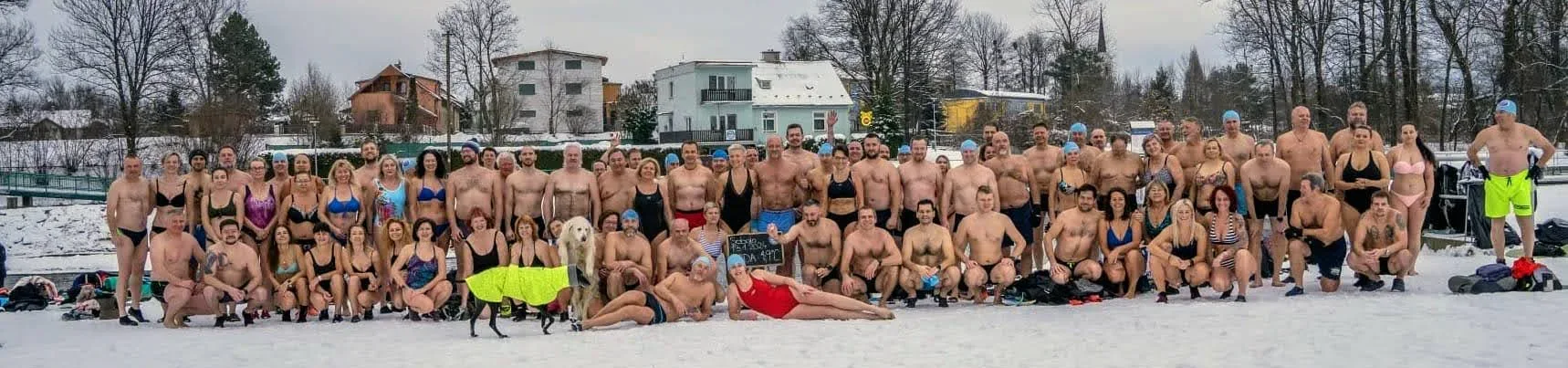
Find an established group that meets regularly. Judge it by what its members actually do at the water, not by its social media following. Check that they know safe entry and exit points, look out for one another and genuinely accompany newcomers.
A larger, established group has another practical advantage: the swim still happens when a couple of people cannot make it. With a tiny group, it is all too easy for three people to fail to agree on a time, leaving one to go alone and the other two not to go at all. That helps neither safety nor regular attendance.
What I think a first dip should look like
No fanfare. No records. Nothing to prove.
- Choose a familiar spot with a safe way in and, above all, a safe way out.
- Lay out your towel and dry clothes in the order you will need them afterwards.
- Tell your experienced companion that this is your first time in cold open water.
- Stay close to a safe exit, in water and conditions you can manage.
- Keep your first dip deliberately short. Do not wait for the water to convince you that you have had enough.
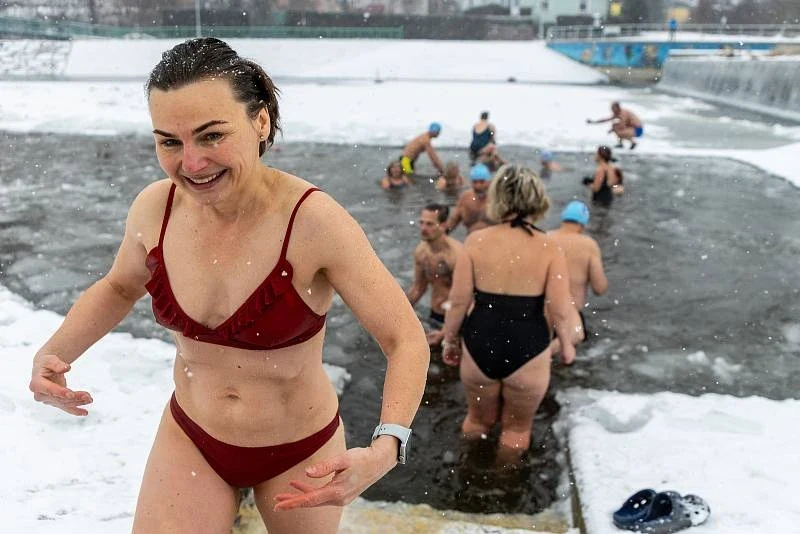
The RNLI recommends entering cold open water slowly and allowing time for your breathing to adjust. That is a sensible approach for a beginner. Experienced winter swimmers sometimes enter more quickly or jump feet first into familiar water. But what an experienced person chooses to do after years of practice in a place they know inside out is not automatically a set of instructions for a newcomer on day one.
At U Žida, a newcomer takes their first dip with an experienced cold-water swimmer. We talk, watch their breathing and movement, and they get out when we tell them to — rather than waiting until they have proved they can last as long as everyone else. It might be a minute, two minutes or less. You are not missing out. The river will still be there in a few days.
How long should you stay in? Do not put your faith in one magic chart
Charts circulate online assigning a precise number of minutes to each water temperature. I used to use similar charts as rough guides myself. Today, I do not consider them an adequate rule for an individual.
The same water affects people differently depending on experience, health, build, wind, movement, fatigue and how quickly they can get dry afterwards. “One minute per degree” may be wonderfully easy to remember, but nature and the human body do not follow such neat arithmetic.
A beginner should deliberately keep their time in the water short. If you cannot settle your breathing, feel less confident in your movements or feel unwell, head back to the exit. Do not wait for a dramatic warning sign. Above all, do not add extra minutes simply because a more experienced swimmer beside you is still in.
We are devoting a separate article to How long should you stay in cold water?, because an honest answer needs more than one number in a colourful Facebook graphic.
Equipment: swimwear, a towel and common sense
You do not need to buy half a sports shop for your first dip. You need swimwear, a large towel, dry clothes, suitable footwear for getting to the water and something to put your wet things in quickly. A swimming cap is useful. Water shoes make sense where you do not know the riverbed or there may be broken glass and sharp stones.
Gloves, neoprene socks, a watch, a thermometer, a changing poncho and other equipment can be useful, depending on the location and what you want to do. None is a prerequisite for getting started. And none makes you a better cold-water swimmer.
By the way, your hands are part of your body. Some people keep them out of the water because the cold is uncomfortable on their fingers. I understand that. But let us not turn it into a universal rule for doing this properly. If you actually want to swim, you will need your hands in the water. Start with short sessions and give them time to adapt, rather than trying to prove something on day one.
Getting out is not the finish line
Think about getting out before you get in. Afterwards, dry yourself, get dressed and pay attention to how you feel. Do not leave on your own if your coordination is affected, you feel confused or your condition is getting worse rather than better. These are also among the warning signs of hypothermia listed by the NHS. Alcohol is not a safe way to warm up, and the NHS specifically advises against it when hypothermia is suspected, however traditional a riverside drink may seem.
Many of us go for a gentle run once we are dressed. We find it helps us warm up, and it is part of the social occasion too. But that is our group's experience, not a medical prescription for everyone. Someone who feels unwell should not start running automatically just because everybody else is doing it.
Shivering after a swim is not a medal, and it is not the aim of cold-water swimming. Cooling down a little and warming up again are part of winter swimming, but severe or prolonged difficulties are not proof of “a good training session”. They tell you that something needs to change next time — most often, spending less time in the water.
Seven claims I would not put my faith in
- “You cannot go into a river unless you have been taking cold showers.” You can, provided the conditions are safe and you have an experienced companion.
- “The longer you last, the greater the benefit.” No. Staying longer may simply mean getting colder.
- “If you are not shivering, it did not work.” Shivering is not a measure of quality.
- “One course will make you a cold-water swimmer.” It makes you someone who has completed a course. Regular practice is what makes you a cold-water swimmer.
- “A breathing technique will protect you from everything.” It will not protect you from currents, an off day, a health complication or your own poor judgement.
- “Water temperature alone tells you the exact safe time.” It does not. Temperature matters, but it is not the only variable.
- “A proper cold-water swimmer has to suffer.” They do not. Some discomfort is part of starting out; suffering is not the goal.
So how should you start?
Keep it simple:
- Be honest about your health.
- Find an experienced group and a safe location.
- Get your things ready before entering the water.
- Keep your first dip short.
- Come back and build up gradually.
Doing cold-water swimming well does not mean staying in the longest. It means being able to return safely and looking forward to it. When it becomes an ordinary part of your week, you are on the right track. If you turn it into a one-off act of heroism, an expensive ritual or a battle of egos, I think you have missed the point.
If you would like to start in Frýdek-Místek, read our For newcomers page and arrange your first Saturday dip in advance. It has the current location, times, equipment advice and contact details. I also recommend 10 myths about cold-water swimming and Ota Zemek's discussion with AI about cold-water shock.
Sources and the limits of this article
- RNLI: Open Water Swimming Safety Advice
- British Heart Foundation: Cold water swimming – is it bad for your heart?
- Barwood and colleagues: Habituation of the cold shock response — a systematic review
- NHS: Hypothermia
This article combines the author's many years of practical experience with basic safety guidance from the organisations above. It is not a substitute for an individual health assessment.