
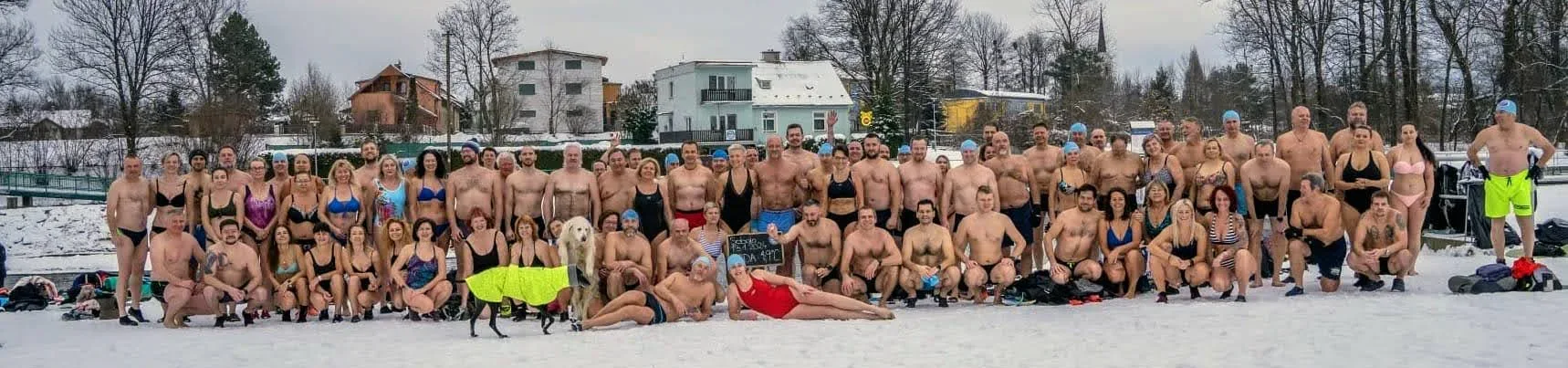
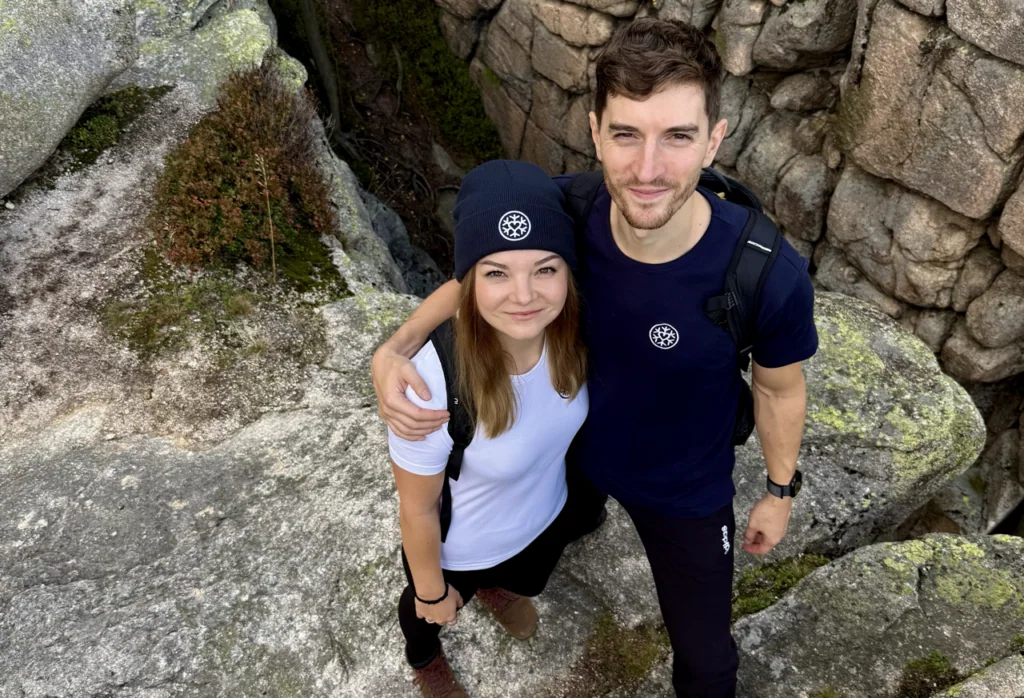
Recently, Honza Pospíšil asked me about Otužilci FM and the JSEM TU! app. This time, I decided to turn the tables. I wanted to get to know the person behind Otužování.cz: what brought him to cold water, where his ideas come from, and why he believes in connecting people who have already made something useful.
Following the earlier interview about our group, I am taking a look from the other side. The conversation covers beginners by the water, breathing, mushroom pickers and chimney sweeps, artificial intelligence, and how Otužování.cz and JSEM TU! could complement each other. Honza replied by email on 26 October 2026.
Interview by Otakar Zemek · Answers by Jan Pospíšil · Translated from Czech
A friend introduced him to cold water
In the OTUŽKO story, you write that you and Tereza started cold-water swimming in 2017. Take us back to the beginning: where were you, whose idea was it, and what made you return to the cold water a second time?
It began with my friend Hanka Šinalová Moravčíková. In 2017, she came back from a course with Wim Hof and told me about cold-water swimming. I like a challenge, so I think I went into the water with her the very next day. And we have been going regularly together ever since :)
What did you expect from cold-water swimming then, and why do you go to the water today? I am particularly interested in something it changed in your everyday life that you would never have expected at the start.
I mainly expected a challenge. What really surprised me was the improvement in my health. I used to be ill every winter, sometimes several times. Since I started exposing myself to the cold regularly, I have rarely been ill, and when I am, it is usually brief and mild. Whether that is only down to the cold, or also to spending more time outdoors and being more active, I cannot say :)
You have helped with courses for beginners for several years. Can you recall a person or a situation that taught you something important about guiding others through fear? In our group, I find that every beginner needs a slightly different approach.
Since 2020, I have helped Hanka organise weekend courses, mostly Wim Hof Method courses in Pec pod Sněžkou, Przesieka in Poland, and Šumava. Since 2022, I have also led the Oxygen Advantage breathing sessions as an instructor. I am often by the water with beginners as an assistant. What has taught me the most is the power of the group and shared motivation. Also, age, fitness, gender or anything else does not determine how resilient someone is, how they can push beyond their limits or how mentally strong they are. I agree with you that different things suit different people. Three things are firm principles for me: never go cold-water swimming alone, never combine intense breathing exercises with water, and respect your own limits.
You are also an Oxygen Advantage instructor, and your profile says you started exploring conscious breathing in 2017. What came together in your life then to spark such an interest in cold water and breathing?
That is right, and two things came together for me in 2017. Hanka took me into cold water, and sport brought me to breathing: I was looking for ways to improve sustainably over the long term, so I could keep it up as I grew older. That led me to the Buteyko and Oxygen Advantage methods. I took an Oxygen Advantage course in 2020, earned my instructor certification two years later, and now lead courses with Hanka. Cold water and breathing make sense together to me: both are about how the body handles strain and how I can calm myself within it.
From first websites to useful projects
Your professional website starts the story with your own online shops back in 2008. But where did your relationship with programming begin? Do you remember the first thing you created yourself that somebody else actually used?
I started building small websites back in secondary school because I enjoyed it. Above all, I liked the idea of turning a thought into something visible that could ideally help other people too. That gradually led me to SEO and online marketing in general. From 2008, I built and sold my own online shops, learning SEO and PPC at a time when Facebook advertising was still new.
You have worked in customer-experience research at Ipsos, led marketing, and run your own projects. Which experience most changed how you build things for people today? Did practical experience completely overturn any of your ideas about business?
I learned a great deal at the agency where I worked. Between 2015 and 2017, I had the opportunity to work on customer-experience research for major Czech brands, and I learned that behind every number are real people. I then spent two years leading marketing in several startups. That is why I still start with what people actually look for and do, rather than with what I think.
Alongside cold-water swimming, your projects include Mykoindex for mushroom pickers and Revizit for chimney sweeps and inspection technicians. How do you find your way into such different worlds? How do you know an idea deserves months of your life?
I got into mushrooms through my wife, who has picked them since childhood, and into chimney sweeps while looking for a new challenge. Mykoindex.cz is a mushroom forecast: using Czech Hydrometeorological Institute data on rainfall and temperature, along with soil moisture, it estimates whether it is worth heading into the forest. Revizit.cz is an online tool where chimney sweeps and inspection technicians manage customers, appointments and reports. Mykoindex and Otužování have one thing in common: they are built on open data from the Czech Hydrometeorological Institute. Before I give an idea more time, I check how many people search for the subject, who already works on it, and whether the problem really matters to people.
Why Otužování.cz came into being
With JSEM TU!, I started from what I was missing when organising our group. What was that initial moment for Otužování.cz? Can you remember a particular situation when you realised you really needed to create a website like this?
I regularly checked the temperature of the Vltava in Braník, and the Czech Hydrometeorological Institute website was not very user-friendly for that. So I decided to try making something of my own. More features gradually followed: a map of cold-water swimming locations, saved favourites, a cold-water swimming difficulty index, and now an online dip diary. Today, Otuzovani.cz shows live water temperatures from 255 institute stations. There are also plenty of myths and exaggerated promises surrounding cold-water swimming, so I wanted every claim to show what it was based on. I started building it in April this year.
At Otužování.cz, you emphasise sources and distinguish research from personal experience. While preparing it, did you encounter something you had long believed as a cold-water swimmer but had to revise? How does your opinion change when you have tried something yourself?
On the website, we separate two things: experience tells us what happened to me; studies tell us what applies to most people. We therefore always label personal experience as such and state how strong the evidence is for each benefit. When we reviewed the website's facts against studies again this October, we also corrected things commonly claimed about cold-water swimming. For example, that a cold bath after training always helps: it probably reduces muscle soreness, but frequent cold baths after strength training hinder gains in strength. I keep my own experience; I simply do not present it as a rule for everyone.
In your first email, you told me you were adding dip logging to your website and immediately offered space for JSEM TU! too. How do you decide what to build yourself and where to join forces with someone else? What could the Czech cold-water swimming community achieve together that is not happening yet?
I focus on places and water: the map, temperatures, location descriptions, and now the diary, which provides a summary from swimmers at each location, such as the most recent water temperature someone measured. We deliberately do not collect time spent in the water; I do not want to push anyone towards staying in longer. Joining forces makes sense where someone already does something well. JSEM TU! handles the group, schedule and attendance. I would not build that again, which is why we recommend it to people setting up a club and at the U Žida weir. Together, we could know the actual water temperature where people swim. Institute stations can be far away; the nearest one to U Žida is about 1.5 km from the weir. Club sensors and diary entries could therefore produce a map that nobody has today.
Working with AI and turning ideas into real things
You write that you design, build and develop your own websites. What does your work really look like today: what do you program yourself, where do other people or AI help, and which part of creating things do you still enjoy most?
That is right, although today I no longer write the code myself line by line. I decide what will be created and why, describe how it should work, and check the result. AI writes much of the code and the first drafts of text, and I fine-tune the details. With health-related writing, I have learned not to trust AI blindly, so every claim must have a traceable study. The website has automated checks for things such as typical AI phrases, and we regularly review the facts against original sources. At OTUŽKO it is different: my wife handles products, content and marketing, while I handle manufacturing, finance and operations. What I enjoy most is still what I enjoyed at the start: seeing an idea become something people actually use.
You and Tereza founded OTUŽKO after years of your own experience with cold water. What exactly was missing on the riverbank that led you to make your own products? And what surprised you most on the journey from an idea to the first finished product?
That is right. We founded OTUŽKO in 2025, after eight years of cold-water swimming ourselves. On the bank, we were missing a poncho you could manage even with numb hands, without cords or zips, that kept the wind out around the sleeves and had enough room to change in. And a kilt that let you change without exposing yourself. We looked around and tried what was available, but found nothing like that, so we designed it ourselves. They are sewn in Czechia from bamboo terry cloth.
“JSEM TU! handles the group, schedule and attendance. I would not build that again, which is why we recommend it to people setting up a club and at the U Žida weir.”
Jan Pospíšil
Thank you for the interview, Honza
I thank Honza for his time, his open answers, and the space he gives our group and JSEM TU! on his website. I recognise my own experience in Honza’s story: a useful idea often begins with something a person is missing themselves. One person wants an easy way to check a river's temperature; another needs to bring together the people who regularly go there.
Connecting local measurements and diaries with a map is an idea for the future. For now, it already makes sense to show each other what works. I would love to continue this conversation with Honza by the water next time.
Explore Honza's work at Otužování.cz and his professional story at janpospisil.cz. Our Recommendations also introduce Otužování.cz and OTUŽKO. For the app that grew from the needs of Otužilci FM, visit the JSEM TU! website.
On the discussion of post-training recovery: a review of studies on muscle soreness (2022) and a meta-analysis of effects on strength gains (2022). Results depend on how cold water is used and on the conditions of individual studies.
Photo: OTUŽKO.